

By Temitope Alade
The Cretan Bull: Mythology, Symbolism, and Legacy
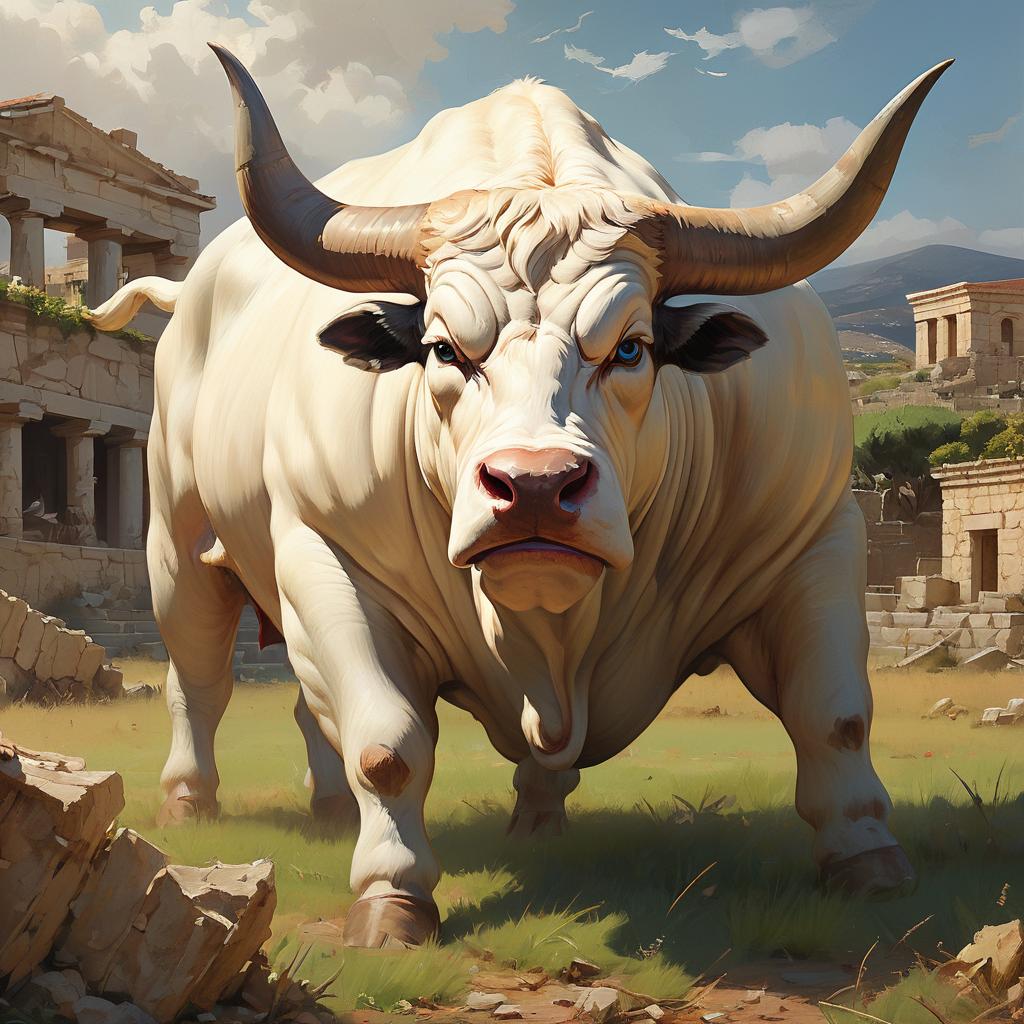
The Cretan Bull is one of the most famous mythological creatures from ancient Greek mythology, known primarily for its role in the Twelve Labors of Heracles (Hercules). This magnificent and powerful beast symbolizes raw strength, untamed nature, and divine punishment. Its story intertwines with gods, heroes, and legendary quests, reflecting the rich tapestry of Greek myth.
Origins and Description
The Cretan Bull was a magnificent, majestic creature that stood out for its size and power. According to myth, it was sent by the god Poseidon, the god of the sea, earthquakes, and horses, to King Minos of Crete. The bull was originally intended as a divine offering—Minos was to sacrifice it to Poseidon as a sign of respect and gratitude for helping him gain the throne.
However, Minos was so impressed by the beauty and strength of the bull that he decided to keep it for himself and sacrifice a lesser bull instead. This act of hubris angered Poseidon, who cursed Minos by making the bull wild and uncontrollable. The bull rampaged through Crete, causing destruction and chaos.
The Role in the Myth of the Minotaur
The story of the Cretan Bull is closely linked to the myth of the Minotaur, the half-man, half-bull creature. After the bull became wild, Minos’s wife, Pasiphaë, was cursed by Poseidon to fall in love with the bull. This unnatural union resulted in the birth of the Minotaur, a monstrous creature that lived in the labyrinth designed by Daedalus beneath Minos’s palace in Knossos.
The Cretan Bull, therefore, is not only significant as a creature of divine wrath but also as a progenitor of one of Greek mythology’s most fearsome monsters.
The Capture of the Cretan Bull: Heracles’ Seventh Labor
The Cretan Bull’s most renowned role is in the Seventh Labor of Heracles, one of the Twelve Labors the hero was tasked with completing as penance. King Eurystheus ordered Heracles to capture the wild bull and bring it back alive.
Heracles traveled to Crete, wrestled the bull, and successfully captured it without killing it. He then brought the bull back to Eurystheus, who, fearful of the beast’s power, released it. The bull eventually escaped and wandered to Marathon in mainland Greece, where it continued to cause havoc until it was killed by the hero Theseus.
This labor showcased Heracles’ strength, bravery, and cunning, as capturing a wild, divine creature without killing it was no small feat.
Symbolism of the Cretan Bull
The Cretan Bull embodies several key themes in Greek mythology:
-
Divine Retribution: The bull’s rampage is a direct punishment from the gods, reminding mortals of the consequences of disrespecting divine will.
-
Raw Power of Nature: As a wild beast, the bull represents untamed natural forces, dangerous and beyond human control.
-
Human Hubris: Minos’s decision to keep the bull rather than sacrifice it shows pride and arrogance, common themes in myths warning against disrespecting the gods.
-
Cycle of Violence: The bull’s story leads to the Minotaur, symbolizing how sin and punishment can spawn new, more dangerous problems.
Cultural and Artistic Depictions
The Cretan Bull has been a popular subject in ancient Greek art, especially vase paintings and frescoes. It often appears in scenes depicting Heracles’ labors or the myths of Crete. The bull is usually portrayed as a large, muscular animal, sometimes with exaggerated features to emphasize its wild nature.
In Minoan civilization, which predates classical Greece, bulls held sacred status, as seen in the famous “Bull-Leaping Fresco” from Knossos. This suggests that the myth of the Cretan Bull may have roots in real Minoan religious practices that revered bulls as symbols of fertility and power.
Legacy and Modern Influence
The myth of the Cretan Bull continues to resonate in modern culture:
-
Literature and Film: The bull appears or is referenced in various adaptations of Greek mythology in books, movies, and television shows.
-
Symbolism: The bull remains a symbol of strength and defiance, often used metaphorically in sports teams, brands, and art.
-
Psychology and Archetypes: The story of Heracles and the bull is sometimes analyzed as an archetype of confronting and mastering wild, chaotic forces within the self.
The Cretan Bull is much more than a mythological creature; it is a symbol of divine power, human folly, and the eternal struggle between civilization and wild nature. From its origins as a divine gift turned curse, through its role in spawning the Minotaur, to its capture by Heracles, the bull’s story is woven deeply into the fabric of Greek mythology. Its enduring legacy continues to inspire and caution, reminding us of the complex interplay between gods, humans, and the forces of nature.
Why Mike Adenuga is compared to the Cretan bull!
Mike Adenuga, the Nigerian billionaire businessman and founder of Globacom, is often compared to the Cretan Bull in a symbolic or metaphorical sense—not because of any mythological origin, but due to the qualities and traits both are perceived to represent. Here’s a breakdown of why that comparison is made:
🔹 1. Raw Power and Influence
-
Cretan Bull: A creature of immense strength and divine power, feared and respected.
-
Mike Adenuga: Known as one of Africa’s most powerful and reclusive business figures, Adenuga wields significant influence in telecommunications, oil, and banking. His financial might and business reach are enormous—earning him the nickname “The Bull” in Nigerian business circles.
🔹 2. Unstoppable Force
-
Cretan Bull: Rampaged across Crete and later Greece, untamable until subdued by heroes like Heracles.
-
Mike Adenuga: Broke into heavily monopolized sectors like telecom with Globacom, Nigeria’s first indigenous GSM operator, and disrupted the market with innovation (e.g., per-second billing). He moved boldly and independently, often against odds.
🔹 3. Mystique and Fearless Independence
-
Cretan Bull: A mysterious force of nature, linked to the gods and feared by all.
-
Mike Adenuga: Famously private and media-shy, Adenuga rarely grants interviews and avoids public limelight, which enhances his mystique. Yet he commands respect in both political and corporate spheres.
🔹 4. Connection to Wealth and Divinity
-
Cretan Bull: A divine creature sent by Poseidon, central to myths involving kings and gods.
-
Mike Adenuga: His rise in wealth and power is often seen as almost mythical—growing a business empire through sheer grit, vision, and audacity. Many see his success as being larger-than-life.
🔹 5. Symbol of Nigerian Tenacity
-
Much like the Cretan Bull’s representation of raw Greek divinity, Adenuga is seen as a symbol of Nigerian entrepreneurial strength—a figure who forged ahead without relying on legacy or foreign backing, earning his empire through bold moves and strategic risk-taking.
Final Thought:
So, comparing Mike Adenuga to the Cretan Bull is more allegorical than literal. It reflects:
-
His immense power and impact
-
His fearless disruption of established systems
-
His enigmatic presence
-
And his role as a force to reckon with, both admired and rarely challenged.


