

By Deji Osas
The Growing Debate
Electric vehicles (EVs) are rapidly changing the way we think about transportation. With zero tailpipe emissions, smooth acceleration, and lower maintenance costs, they are often hailed as the future of mobility. Governments worldwide are even setting deadlines to phase out internal combustion engine (ICE) vehicles in favor of EVs.
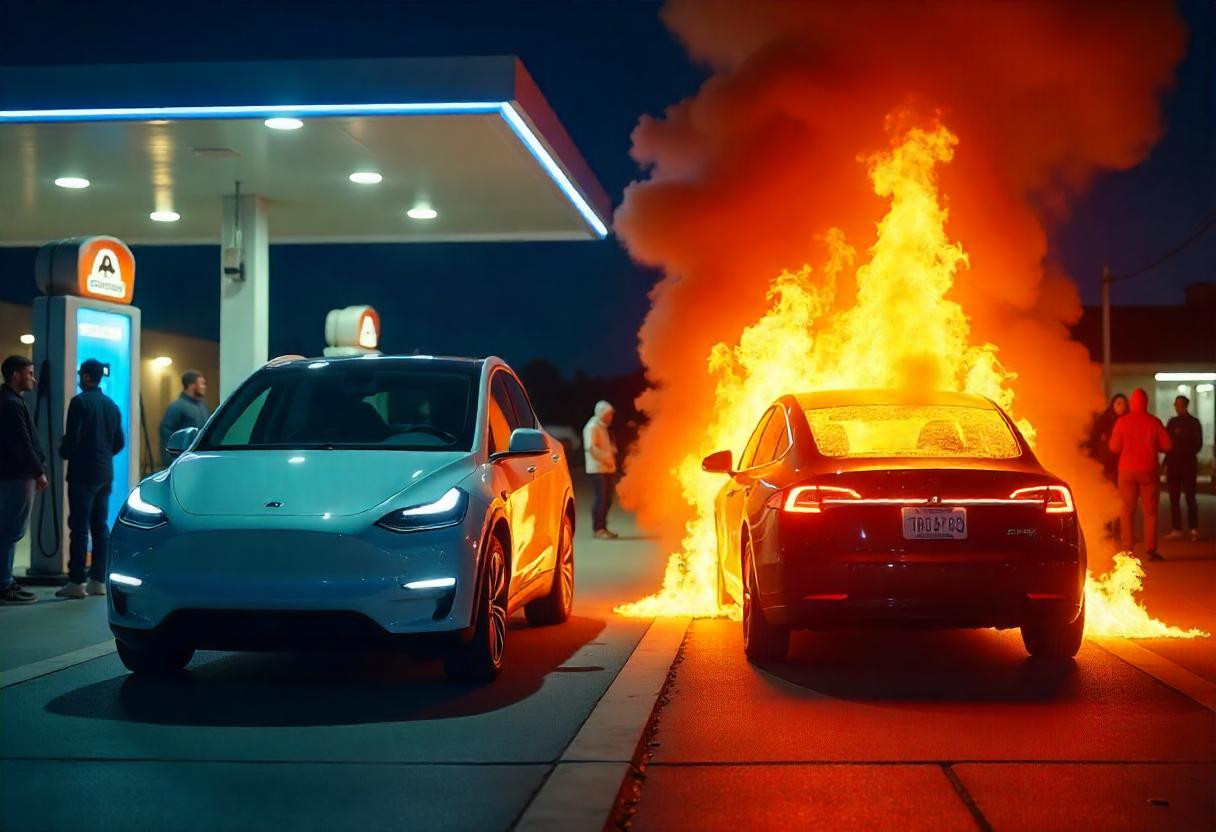
But with every technological revolution comes skepticism. One of the most persistent concerns is whether EVs are more prone to fire risks than traditional cars. Videos of Teslas engulfed in flames, headlines about battery explosions, and viral social media posts have fueled public fears. But how much of this is fact, and how much is misinformation?
To answer the question—are electric vehicles really a fire risk?—we must examine the science behind EV batteries, compare fire data with gasoline vehicles, and explore safety measures being implemented across the industry.
The Science Behind EV Fires
At the heart of every EV is a lithium-ion battery pack. These batteries are highly energy-dense, storing vast amounts of electricity in a compact space. This is what allows EVs to travel hundreds of miles on a single charge.
However, lithium-ion batteries carry an inherent risk of thermal runaway. This occurs when a cell overheats and triggers a chain reaction, causing other cells to ignite. Once started, thermal runaway is extremely difficult to stop, and it can result in intense, long-lasting fires that require special firefighting techniques.
Causes of thermal runaway include:
-
Manufacturing defects – rare, but can create internal short circuits.
-
Physical damage – from collisions or punctures.
-
Overcharging or faulty electronics – leading to overheating.
-
Exposure to high heat – such as external fires spreading into the battery.
It’s important to note that lithium-ion batteries are not unique to EVs—they are also found in laptops, phones, e-bikes, and even airplanes. The difference is scale: an EV battery is massive, often weighing hundreds of kilograms, so if something goes wrong, the consequences can be more dramatic.
Comparing EV Fires to Gasoline Fires
The perception of EV fire risk is often amplified because each incident tends to make headlines. But when you look at the numbers, a different picture emerges.
According to multiple studies, gasoline-powered vehicles are far more likely to catch fire than EVs. For example, data from the National Fire Protection Association (NFPA) and U.S. Fire Administration show that:
-
ICE vehicles: About 1,500 vehicle fires per 100,000 sales.
-
Hybrid vehicles: About 3,500 fires per 100,000 sales (due to having both gasoline and batteries).
-
EVs: Fewer than 30 fires per 100,000 sales.
This means that while EV fires tend to be more complicated and harder to extinguish, they are significantly rarer than fires in traditional vehicles.
The reason gasoline vehicles catch fire more often is simple: they contain flammable fuel and hot engines. Every car accident risks fuel leaks, oil spills, and ignition sources. In contrast, EVs have fewer moving parts and no flammable liquids.
So, while EV fires make headlines, statistically, your gasoline car is far more likely to catch fire than your Tesla or Hyundai Ioniq.
Why EV Fires Get So Much Attention
If EVs are less likely to catch fire, why do they get more media coverage? The answer lies in three factors:
-
Novelty – EVs are still relatively new, so unusual incidents spark public curiosity.
-
Severity of Fires – EV battery fires burn hotter, last longer, and require thousands of gallons of water to extinguish. This makes them visually dramatic and harder for first responders to handle.
-
Social Media Amplification – Viral videos of burning EVs circulate faster than statistics showing EVs are safer.
For instance, when a Tesla fire occurs, it often trends worldwide. Meanwhile, thousands of gasoline vehicle fires happen daily across the globe, rarely making the news because they are seen as “normal.”
This imbalance in reporting feeds the perception that EVs are uniquely dangerous, when in fact the opposite is true.
Safety Measures and Innovations
Automakers and regulators are not ignoring the fire risk. In fact, EV safety standards are among the most stringent in the auto industry.
Key safety measures include:
-
Battery Management Systems (BMS): These monitor temperature, voltage, and current to prevent overheating.
-
Reinforced battery casings: Protect cells from physical damage in crashes.
-
Automatic disconnects: Cut off power in accidents to prevent sparks.
-
Cooling systems: Keep batteries at optimal temperature, even in extreme weather.
Governments have also introduced rigorous testing, requiring EVs to pass fire, crush, and impact tests before approval. Fire departments worldwide are being trained to handle EV-specific fires, and some cities are equipping themselves with special cooling blankets and immersion tanks.
Meanwhile, next-generation battery technologies—such as solid-state batteries—promise to drastically reduce fire risks by using non-flammable electrolytes. Companies like Toyota, QuantumScape, and CATL are leading this push, aiming for safer, more stable EV batteries within the next decade.
Conclusion – Balancing Risk and Reality
So, are electric vehicles a fire risk? The answer is nuanced. Yes, EV batteries can catch fire under certain conditions, and when they do, the fires are difficult to extinguish. However, compared to gasoline vehicles, the overall risk is far lower.
The public perception of EV fire danger has been shaped more by viral headlines than by hard data. In reality, owning an EV is statistically safer than owning a gasoline car when it comes to fire hazards.
As technology improves and solid-state batteries become mainstream, the fire risks will only decline further. For now, drivers should take the same precautions they would with any vehicle: follow manufacturer guidelines, avoid tampering with electrical systems, and ensure regular maintenance.
In the end, EVs are not fireproof—but neither are traditional cars. What’s different is the kind of fire risk, not the frequency. For the future of mobility, that means the benefits of EVs—cleaner air, lower running costs, and technological progress—far outweigh the exaggerated fears of battery fires.

