
Society Gist
Otinosa Williams
A Tragic End to a Promising Career
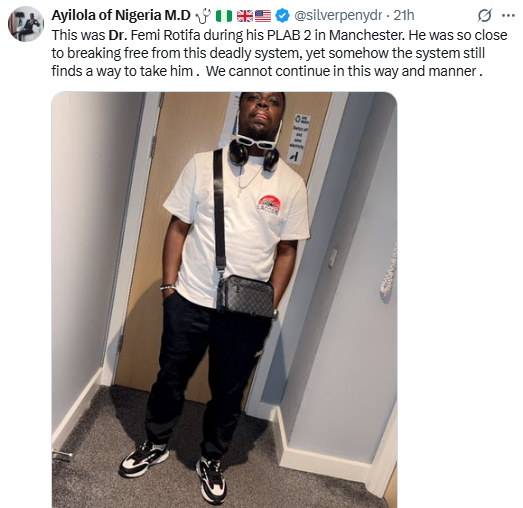
The Nigerian medical community has been thrown into mourning following the sudden death of Dr. Femi Rotifa, a young resident doctor at the Rivers State University Teaching Hospital (RSUTH), Port Harcourt. Dr. Rotifa, who had been preparing to relocate to the United Kingdom for greener pastures, reportedly collapsed and died after completing an exhausting 72-hour duty shift in the hospital’s Emergency Room.
According to colleagues, the 30-year-old physician had been on continuous call duty for three days, attending to patients with little or no rest. After finally retreating to the doctors’ call room to rest, he slumped and could not be revived. Despite frantic efforts by his fellow doctors to resuscitate him, he was confirmed dead on Tuesday, September 2, 2025.
The incident has raised serious concerns about the increasing workload faced by Nigerian doctors, many of whom are stretched thin due to the country’s chronic shortage of medical professionals.
“A Death on Duty” – NARD Reacts
Confirming the incident, the President of the Nigerian Association of Resident Doctors (NARD), Dr. Tope Osundara, described Dr. Rotifa’s death as both shocking and heartbreaking.
“What happened is that he was on call in the Emergency Room for several days without relief. Afterward, he went to the call room to rest, and it was there that he died. Unfortunately, he was the only one attending to patients during that shift. The overuse of manpower strained his health and led to this painful death. It was truly a death on duty,” Osundara lamented.
NARD has long warned against the dangers of overwork among its members, pointing to the lack of manpower in hospitals across the country as a silent crisis that often leads to burnout, brain drain, and in cases like this, tragedy.
From Port Harcourt to the UK – Dreams Cut Short
Dr. Rotifa was not only a respected resident doctor but also a former President of the Port Harcourt University Medical Students’ Association (PUMSA), where he had distinguished himself as a dedicated leader and advocate for medical students’ welfare.
Friends revealed that he had recently secured registration with the UK’s General Medical Council (GMC) and was awaiting placement in a hospital abroad. His relocation was part of the ongoing wave of Nigerian doctors seeking better opportunities outside the country, driven by poor working conditions, low pay, and overwhelming workloads at home.
Sadly, those dreams were cut short just days before they could be realized.
An Outpouring of Grief
The news of his death has sparked widespread mourning on social media, with friends, colleagues, and former classmates paying tribute to his life and career. Many described him as brilliant, hardworking, and selfless, often going above and beyond for his patients.
One colleague wrote: “We have lost a gem. Femi was not just a doctor, he was a brother, a friend, and a light to everyone who knew him. This is not just his death, it is a wake-up call about the lives of doctors in Nigeria.”
Others used the moment to highlight the harsh realities of practicing medicine in Nigeria, where young doctors are often pushed to the brink due to inadequate staffing and poor hospital management.
The Larger Picture – A Health Sector in Crisis
Dr. Rotifa’s death has once again drawn attention to Nigeria’s worsening medical brain drain and the dire conditions under which many doctors still work. Recent statistics indicate that thousands of Nigerian doctors have relocated to the United Kingdom, Canada, and the Middle East in the past five years alone.
Those who remain in Nigeria are left to grapple with long hours, poor remuneration, and under-resourced hospitals. It is not uncommon for resident doctors to work shifts spanning several days, often with little rest, food, or psychological support.
Health experts warn that without urgent reforms, more lives—both patients and doctors—will be lost. Dr. Rotifa’s death, they argue, is not an isolated tragedy but a symptom of a failing healthcare system.
What Next?
As investigations continue, colleagues and family members are calling for accountability and reforms to prevent a repeat of such tragedies. NARD has urged the government to prioritize the welfare of healthcare workers, insisting that the system must be restructured to protect the lives of those who sacrifice daily to save others.
For now, Dr. Femi Rotifa’s story stands as a painful reminder of the human cost of neglect in Nigeria’s health sector—a promising life cut short not by disease, but by exhaustion and a broken system.
His colleagues at RSUTH have pledged to honor his memory, even as they continue to demand change.
.