

By Gloria Nosa

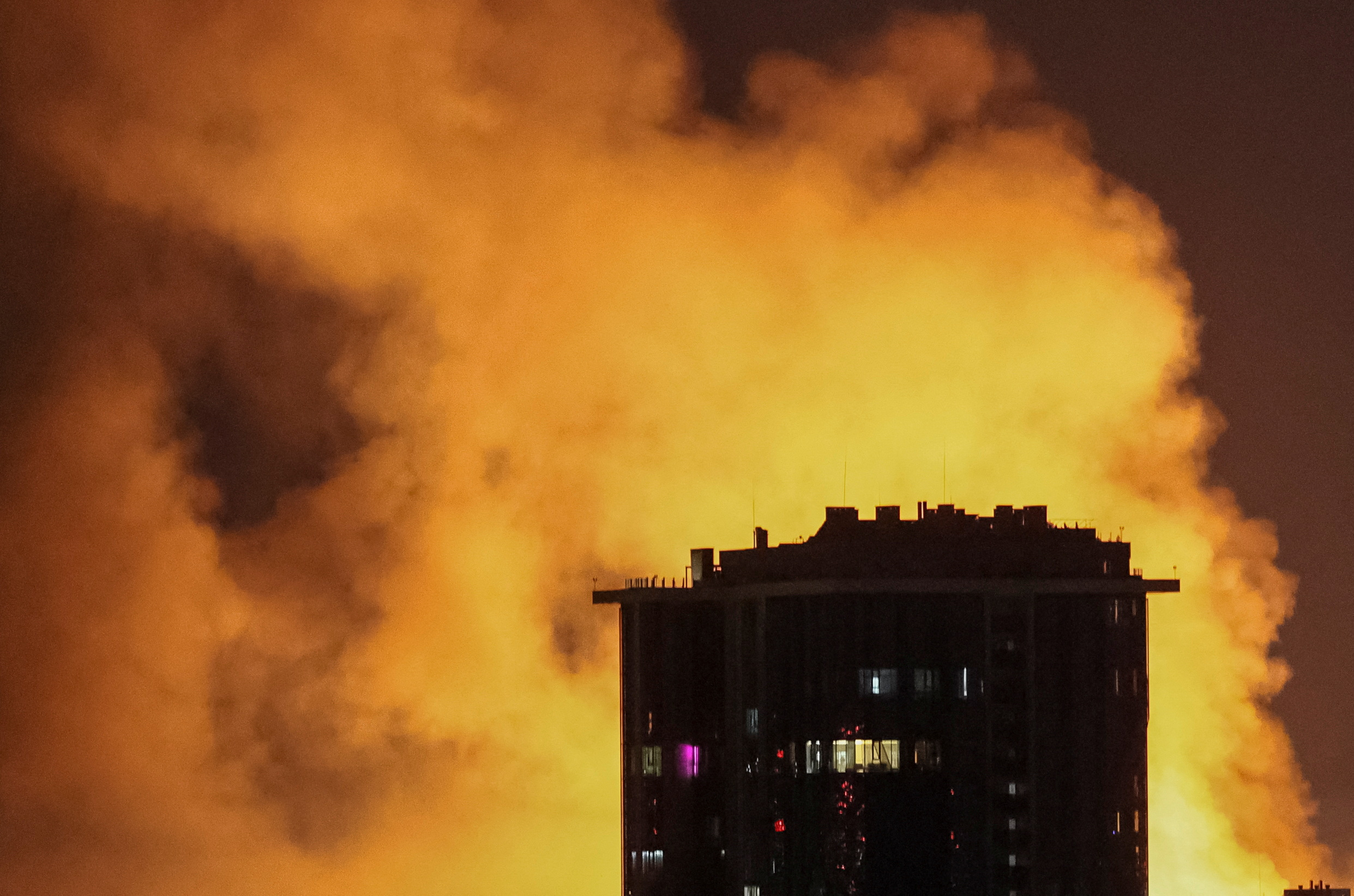
Russia has unleashed its most destructive aerial bombardment since the beginning of the war, striking the very heart of Kyiv and setting Ukraine’s government headquarters on fire. The assault, which killed at least four people and wounded dozens more, marks a dramatic escalation in the three-and-a-half-year conflict that has already claimed tens of thousands of lives.
The overnight barrage, carried out between late Saturday and early Sunday, saw Moscow deploy over 810 drones and 13 ballistic missiles across multiple Ukrainian cities. For the first time, Ukraine’s cabinet of ministers complex—an emblem of the nation’s governance—was directly hit, leaving its roof engulfed in flames and smoke rising into the capital’s morning sky.
Kyiv in Flames and Fear
Emergency crews battled fires throughout the city, as helicopters dumped water on the burning government building. Several high-rise residential blocks were also damaged, with shattered windows, collapsed walls, and residents fleeing for safety.
Among the dead were a mother and her two-month-old son, killed when their apartment block in western Kyiv was struck. In another heartbreaking case, a pregnant woman injured in the attack delivered a premature baby, with doctors fighting to save both lives.
“This has become our reality,” said Olga, a 30-year-old resident whose building was hit by a drone. “First, the Shahed drones come buzzing, and then the rockets follow. It’s like a nightmare that repeats every week.”
The Ukrainian Prime Minister, Yulia Svyrydenko, vowed resilience, promising to rebuild while condemning Russia’s campaign of terror. “We can restore our offices, but we cannot bring back lives lost to this senseless violence,” she said in a video recorded from inside a charred government corridor.
Moscow Denies Targeting Civilians
Russia’s defence ministry claimed responsibility for striking “a logistics hub and industrial facility” in Kyiv but denied hitting the government complex. Officials in Moscow continue to insist they avoid civilian targets, though the images of smouldering ministries and destroyed homes paint a different picture.
President Volodymyr Zelensky described the assault as a deliberate effort to prolong the war at a time when diplomatic options remain on the table. “Such killings now, when peace could already be negotiated, are nothing but crimes meant to drag this war further,” Zelensky said.
The Ukrainian leader spoke with French President Emmanuel Macron soon after the attack, securing promises of further military aid. Macron condemned the strikes as proof that Russia “locks itself deeper into a strategy of war and terror.”
Europe’s Anger, World’s Unease
Reactions from European leaders were swift and united. EU Commission chief Ursula von der Leyen decried the “cowardly strikes” as another sign that President Vladimir Putin “is not serious about peace.” British Prime Minister Keir Starmer said the Kremlin was “mocking diplomacy,” echoing the frustration of allies who continue to search for a negotiated settlement.
Meanwhile, Ukraine’s foreign ministry highlighted the indiscriminate nature of the attacks, noting that alongside human casualties, seven horses at an equestrian club in Kyiv’s suburbs were killed. “The world cannot stay idle while a terrorist state destroys everything—people, homes, even animals,” the ministry wrote on X.
Despite international condemnation, Russia shows no signs of halting its offensive. On the eastern front, Moscow claimed to have captured another village in the Dnipropetrovsk region, pushing deeper into Ukrainian territory in grinding, attritional battles. Currently, Russia controls about 20 percent of Ukraine.
Diplomacy Stalls as War Grinds On
Efforts by U.S. President Donald Trump to broker peace in recent weeks have failed to yield breakthroughs. Washington has pressured Kyiv to consider compromise, but Zelensky insists that Ukraine needs ironclad security guarantees from Western allies before entertaining any deal.
Russia, for its part, has made clear that any deployment of Western troops to Ukraine will be treated as a direct provocation. President Putin has warned that such forces would be legitimate targets, a threat that further complicates European security discussions.
The weekend’s attack came shortly after more than two dozen European nations pledged to patrol and enforce any potential ceasefire deal—an idea that has gained traction as the war drags on but remains distant amid intensifying violence.
The War’s Human Cost
Now in its fourth year, the conflict has devastated Ukraine’s infrastructure, displaced millions, and left entire cities in ruins. Once-thriving communities in the east and south have been reduced to rubble, and families continue to be torn apart by relentless bombardments.
Kyiv’s residents, though hardened by months of sirens and explosions, admit fatigue. “You try to live a normal life,” said Petro, a shopkeeper in the capital, “but when missiles hit your government, you realise no one is safe—not even those at the centre of power.”
As the smoke clears from Sunday’s unprecedented assault, the broader question remains unanswered: is the war entering a new, deadlier phase, or will global pressure finally force both sides to the negotiating table?
For Ukraine, the message from Russia is chillingly clear: the battle for survival is far from over.

