

By John Umeh
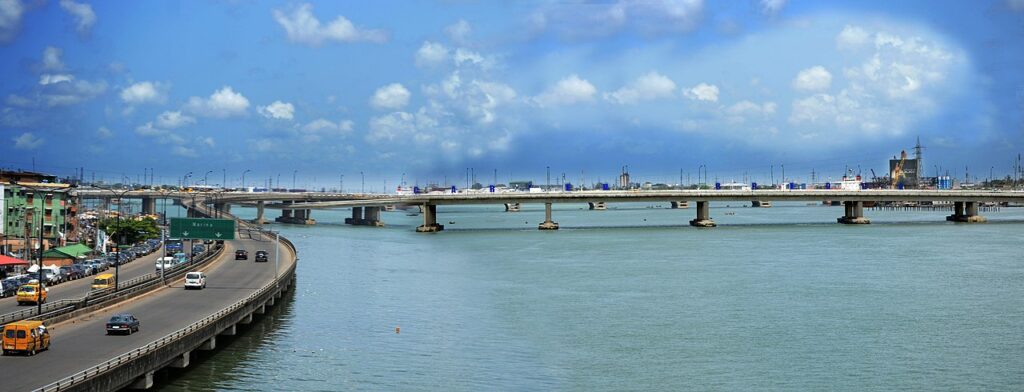
The Federal Government has confirmed that the historic Carter Bridge in Lagos State has reached a critical stage of structural deterioration and can no longer be salvaged. Minister of Works, Senator Dave Umahi, made the disclosure during an inspection visit on Tuesday, stressing that all stakeholders must come to terms with the reality that the bridge is irredeemable and a new alignment will be required.
Inspection Reveals Grim Reality
During the under-deck inspection of Carter Bridge, Umahi explained that the purpose was to assess whether parts of the bridge could still be rehabilitated in order to reduce costs and time for a potential reconstruction project. However, the inspection results painted a bleak picture.
“What we did today is to see whether we can salvage the ramps, so that we cut down the cost of construction and the time of construction,” Umahi said. “That decision, we could not take. We need consultants and Julius Berger to put their observations, and we have instruments we use to determine whether the observations are right or wrong. If the observations are confirmed, then it means that both the ramp and the main axial section of the Carter Bridge will have to go.”
The findings indicate that not only are the ramps beyond repair, but the main body of the bridge has suffered such extensive damage that rehabilitation is no longer feasible.
Historic Background and Past Demolition
Carter Bridge is one of the oldest bridges in Lagos, serving as a vital link between the mainland and Lagos Island for decades. It holds historical significance, being among the earliest colonial-era bridges constructed in Nigeria.
Umahi also drew attention to the fact that the current Carter Bridge sits in the same area where a previous version of the bridge was demolished decades ago using explosives, remnants of which still lie underwater. “Whatever we are doing, we have to consider removal of that so as not to affect our navigational activities,” the Minister explained.
Future Options: New Bridge on a Different Alignment
According to Umahi, the Federal Government is now tasked with making a critical decision: whether to completely replace the bridge by constructing a new one on a different alignment or attempt to temporarily salvage certain portions to remain in use during the transition.
“The critical decision we have to take is: since it seems that all stakeholders are at peace that a new Carter Bridge should be constructed, is there any way we can salvage and repair something to be in use while we take a different alignment?” Umahi asked.
The Minister emphasized that this would require further technical evaluations, engineering input, and consultations with marine authorities to avoid disruptions to navigational activities along the Lagos lagoon.
Comparison with Third Mainland Bridge
While the fate of Carter Bridge now seems sealed, Umahi was quick to assure Lagos residents that the same would not apply to the iconic Third Mainland Bridge, the longest bridge in Africa. Rumors had circulated that the government might demolish it in favor of building a new one, but Umahi dismissed such notions.
“The ministry is not buying the idea of a fresh Third Mainland Bridge,” he clarified. “We will do everything possible to rehabilitate and extend the lifespan of the existing structure.”
Public Safety and Urban Impact
The declaration that Carter Bridge is irredeemable raises significant questions about urban mobility in Lagos, a city already battling severe traffic congestion. Carter Bridge has for years served as an important relief route, easing the burden on both Eko and Third Mainland Bridges. Its loss, even temporarily, could worsen commuting challenges for millions of Lagosians.
Experts say that a new bridge project, while necessary, will require meticulous planning to minimize disruptions. Issues such as environmental impact, funding, land acquisition, and urban resettlement may arise, given Lagos’ dense population and rapid expansion.
Calls for Swift Action
Urban planners and transport analysts argue that while the Federal Government’s declaration may come as a shock, it is a long-overdue decision. “Carter Bridge has shown signs of structural weakness for years. It’s a miracle it has lasted this long without a major incident,” one Lagos-based civil engineer remarked.
Stakeholders are now urging the Federal Government to prioritize the new bridge project, allocate sufficient resources, and ensure transparency in execution. The Lagos State Government is also expected to play a key role in coordinating urban planning and mitigating the socio-economic impact on communities that rely heavily on the bridge for daily commuting.
A Landmark at the End of Its Journey
Carter Bridge, once a proud symbol of Lagos’ modernization and expansion, now faces the inevitable fate of decommissioning. Umahi’s declaration underscores a sobering reality: infrastructure, no matter how iconic, has a lifespan. The challenge ahead for Nigeria’s commercial capital is to replace this fallen giant with a modern alternative that meets the demands of a megacity projected to keep growing for decades to come.
For now, the Carter Bridge stands as a reminder of Nigeria’s infrastructure history—one that must give way for the future of Lagos’ urban development and transportation needs.

