

By John Umeh
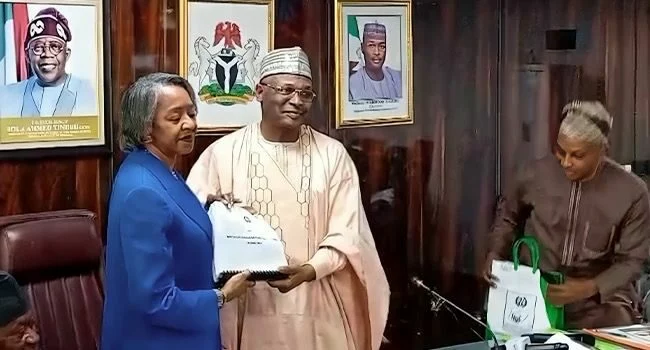
Professor Mahmood Yakubu, the outgoing Chairman of the Independent National Electoral Commission (INEC), has officially stepped down from his position, handing over leadership of the electoral body to Mrs. May Agbamuche-Mbu, who will serve as Acting Chairman.
The transition took place on Monday, October 7, during a meeting with Resident Electoral Commissioners (RECs) held at INEC headquarters in Abuja.
Mrs. Agbamuche-Mbu, the most senior and longest-serving National Commissioner in the commission, will oversee the day-to-day affairs of INEC pending the appointment of a new substantive chairman by President Bola Ahmed Tinubu.
In his brief handover speech, Professor Yakubu expressed gratitude to the commission’s staff for their commitment and dedication during his tenure. He urged them to extend the same level of professionalism and support to Agbamuche-Mbu to ensure continuity and stability within the commission.
“I have today handed over to Mrs. May Agbamuche-Mbu as Acting Chairman of the Independent National Electoral Commission,” Yakubu said. “I urge all commissioners, directors, and staff to give her their full cooperation and maintain the spirit of service and integrity that defines this institution.”
Yakubu, who was first appointed INEC Chairman in 2015 and reappointed for a second term in 2020, presided over two general elections — in 2019 and 2023 — as well as several off-cycle gubernatorial polls. His tenure was marked by major electoral reforms, including the introduction of the Bimodal Voter Accreditation System (BVAS) and the electronic transmission of results.
Mrs. Agbamuche-Mbu, a lawyer and former publisher, has served on the commission since 2016, representing Cross River State. Her appointment as Acting Chairman makes her the second woman to head Nigeria’s electoral body, following Professor Amina Zakari, who briefly held the position in 2015.
As she assumes office, Agbamuche-Mbu is expected to steer the commission through ongoing electoral reforms and preparations for upcoming by-elections across the country.
Yakubu’s exit marks the end of an era defined by significant institutional changes, technological adoption, and public scrutiny, leaving behind a mixed legacy of progress and controversy in Nigeria’s electoral journey.

