By John Umeh
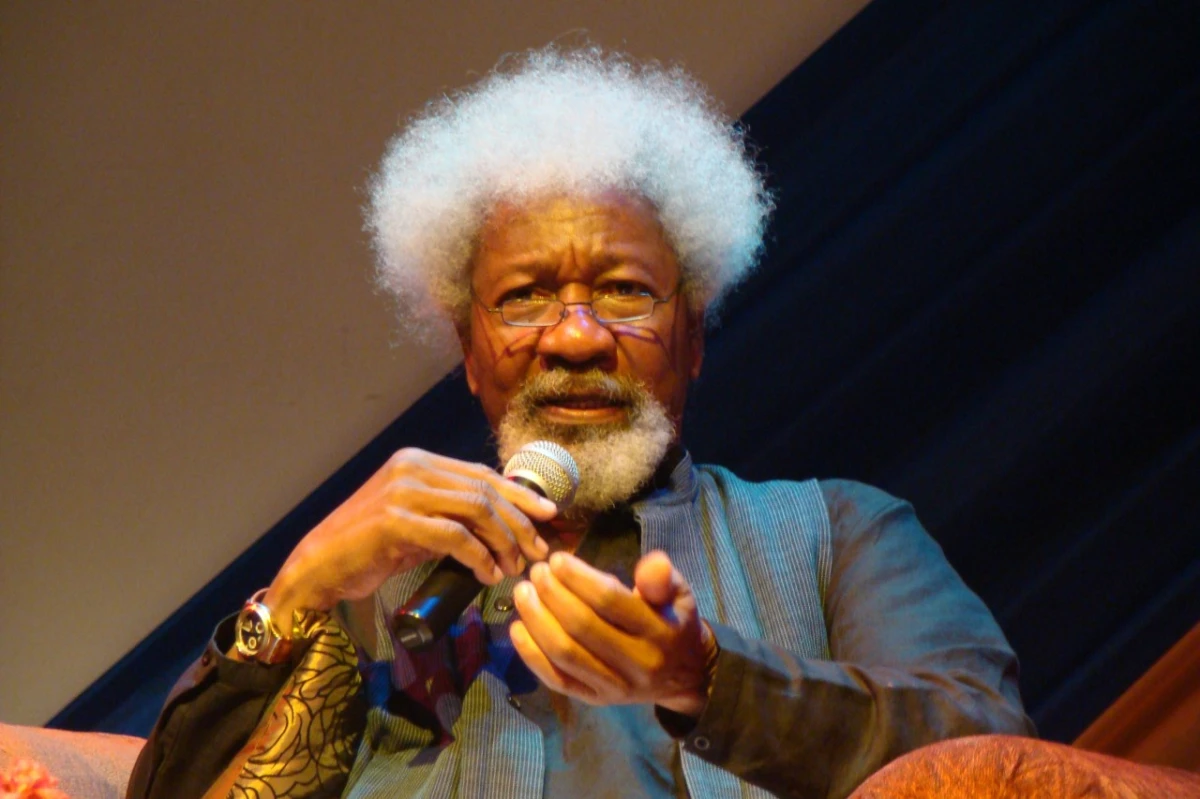
Nobel laureate and literary icon, Professor Wole Soyinka, has publicly disclosed that the United States government has revoked his non-immigrant visa, effectively barring him from entering the country. The revelation came during a fiery media briefing titled “Unending Saga: Idi Amin in Whiteface!” held at Kongi’s Harvest Gallery, Freedom Park, Lagos Island.
During the session, Soyinka expressed shock and disbelief at the development, describing it as an act of political persecution driven by his long-standing criticism of U.S. President Donald Trump.
“I have no visa; I am banned, obviously, from the United States. And if you want to see me, you know where to find me,” the 90-year-old playwright declared before a crowd of journalists and admirers.
Visa Revocation Notice and Details
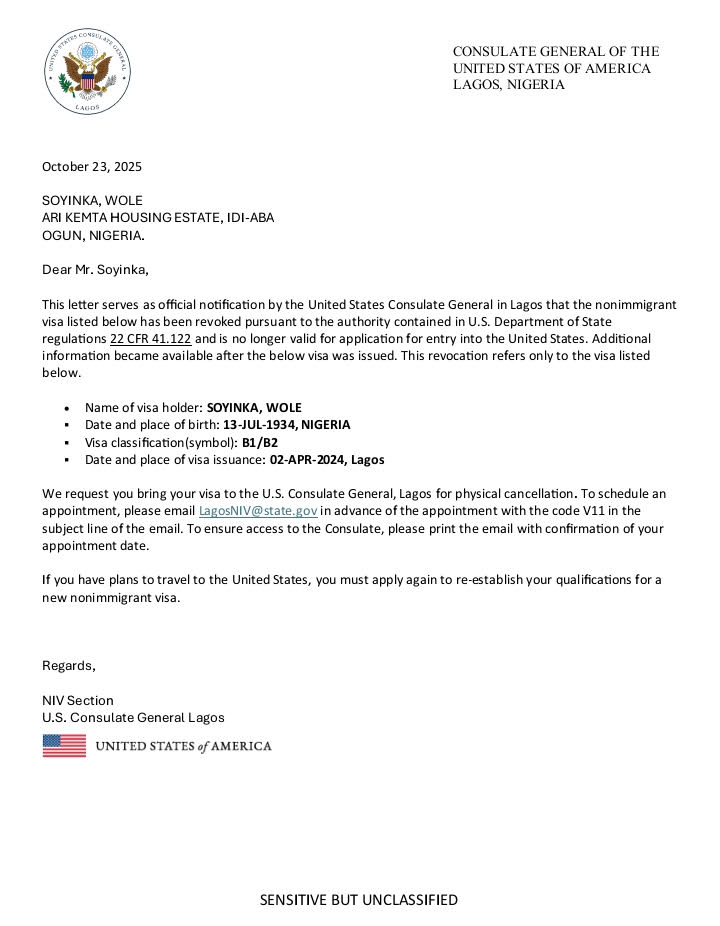
Soyinka revealed that he received the official revocation notice on Thursday, October 23, 2025, from the Non-Immigrant Visa (NIV) Section of the U.S. Consulate General in Lagos. The letter, which he read aloud to the press, stated that his B1/B2 visa—issued on April 2, 2024—had been revoked “pursuant to the authority contained in U.S. Department of State regulations,” following the discovery of “additional information” after issuance.
The revoked document contained the following details:
-
Name: SOYINKA, WOLE
-
Date of Birth: July 13, 1934
-
Visa Type: B1/B2 (Tourism/Business)
-
Issuance Date: April 2, 2024, Lagos
The letter did not specify the nature of the “additional information” that led to the visa cancellation, a vagueness that Soyinka said leaves room for political interpretation.
Soyinka’s Reaction: ‘Witch-Hunted for My Views’
Soyinka stated that he was “still in search of a reason” for the revocation, emphasizing that he has never been charged, arrested, or convicted of any offense either in Nigeria or abroad.
“I’ve looked back through my records—no felonies, no misdemeanors, nothing. I can only assume that my consistent criticism of Mr. Trump’s policies has finally caught up with me,” he said.
The laureate, however, maintained that he harbored no animosity toward the American people, insisting that his issue lies with the current U.S. administration. “I will continue to welcome Americans to my home, provided they come in good faith. My quarrel is not with a nation but with its leadership,” he added.
Soyinka, who has long positioned himself as a voice against tyranny, drew a striking comparison between President Trump and Uganda’s late dictator Idi Amin. “What we are witnessing is tyranny wrapped in democracy—a ‘white Idi Amin’ ruling by ego and fear,” he declared, eliciting murmurs from the audience.
Background: The September Re-Interview Controversy
The visa revocation follows an earlier diplomatic standoff in September 2025 when Soyinka declined an invitation from the U.S. Consulate to attend a “visa re-interview” scheduled for September 11.
At the time, Soyinka said he initially dismissed the invitation as a scam, claiming it resembled fraudulent visa-related schemes. When it became clear that the invitation was authentic, he still refused to attend, describing the process as “demeaning and unnecessary.”
He also took issue with the consulate’s choice of date—September 11—arguing that the day should remain sacred as one of mourning and remembrance in the U.S., not a date for bureaucratic exercises.
“I found it distasteful that a nation should conduct routine visa appointments on a day that symbolizes tragedy for so many. It was insensitive and disrespectful,” Soyinka remarked.
Historical Context: Soyinka’s Longstanding Protest Against Trump
Soyinka’s strained relationship with the U.S. dates back to 2016, when he famously tore up his Green Card after Trump’s election victory. At the time, he had vowed to destroy the residency permit if Trump won the presidency—a promise he fulfilled in a symbolic gesture of protest.
Nearly a decade later, his outspoken criticism of the former U.S. president continues to define his international engagements. Many analysts see the visa revocation as a continuation of that tension.
Final Word: ‘Freedom Is My Visa’
Closing the briefing, Soyinka asserted that no government could silence him or restrict his movement as a citizen of the world.
“I have travelled through dictatorships and democracies alike. None has succeeded in caging me. If the United States revokes my visa today, I still hold the most powerful one—freedom,” he declared, drawing a standing ovation.
He also used the opportunity to urge global leaders to resist “the creeping normalization of authoritarianism disguised as patriotism,” warning that history always remembers those who stayed silent in the face of oppression.