

By John Umeh
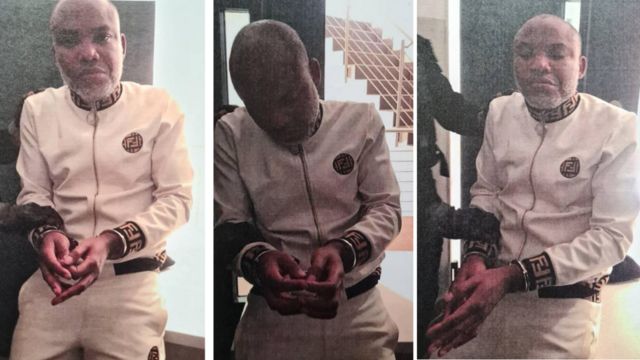
In a landmark judgment that has sparked nationwide reactions, Justice James Omotoso of the Federal High Court in Abuja has sentenced Nnamdi Kanu, leader of the proscribed Indigenous People of Biafra (IPOB), to life imprisonment after finding him guilty of terrorism-related charges.
The ruling, delivered in a tense courtroom session on Thursday, marks one of the most consequential decisions in Nigeria’s counterterrorism legal history. Kanu, who has been at the center of a long-running legal and political battle with the Federal Government, was convicted on multiple counts bordering on terrorism financing, incitement, and actions deemed capable of threatening national security.
Breakdown of the Sentencing
According to the judgment, Kanu received:
-
Life imprisonment on Counts 4, 5, and 6, which the court found to be the most severe and directly linked to acts of terrorism.
-
20 years imprisonment on Count 3, relating to public incitement and inflammatory broadcasts targeting government institutions.
The court stated that these sentences were necessary to “protect national security, deter extremist propaganda, and maintain public order,” adding that the gravity of the offences left no room for leniency.
Courtroom Atmosphere
Inside the courtroom, emotions ran high as Justice Omotoso delivered his verdict. Kanu, dressed in a simple outfit and flanked by security operatives, maintained a stoic demeanor throughout the session. At the moment the life sentence was pronounced, murmurs rippled through the courtroom, prompting security officers to briefly restore order.
According to eyewitness accounts, Kanu’s legal team immediately indicated their intention to appeal the decision, describing the judgment as “politically motivated” and “inconsistent with constitutional protections.” The Federal Government, however, praised the ruling as a major victory for national security.
Reactions and National Impact
The sentencing has drawn widespread reactions from political analysts, human rights groups, and the general public. Supporters of the IPOB leader expressed outrage, arguing that the judgment would deepen tensions in the South-East region. Meanwhile, government supporters hailed the development as a necessary step toward curbing separatist violence and restoring stability.
Security analysts have warned that the ruling may trigger protests or unrest across parts of the South-East, urging security agencies to maintain vigilance while ensuring restraint and professionalism.
A Long and Complex Legal Journey
Kanu’s journey through the Nigerian justice system has been marked by dramatic twists, including his initial arrest in 2015, the controversial bail in 2017, his disappearance from Nigeria after military operations in Abia State, and his re-arrest in 2021 under circumstances that spurred international debate.
Over the years, he has maintained that his agitation for Biafra is rooted in self-determination—a claim the government has repeatedly dismissed as unlawful and dangerous.
Video of Sentencing Emerges
A video capturing the moment Justice Omotoso pronounced the life sentence has since gone viral on social media. The clip, originally shared by Linda Ikeji’s Blog, shows Kanu standing calmly in the dock as the judge reads the sentencing. The video has further fueled public discussion, with many Nigerians debating its implications for the nation’s democracy, human rights record, and unity.

