

By Gloria Nosa
Former South Korean leader Yoon Suk-yeol has been sentenced to life imprisonment after a court found him guilty of orchestrating an insurrection tied to his controversial declaration of martial law in December 2024.
The verdict was delivered by Judge Jee Kui-youn at the Seoul Central District Court and broadcast nationwide. Although prosecutors had pushed for the death penalty, the court opted for life behind bars.
Court: Attempt to Undermine Constitutional Order
In his ruling, Judge Jee concluded that Yoon played a central role in plotting actions that threatened South Korea’s democratic framework. According to the judgment, the former president directed efforts aimed at disrupting constitutional governance and mobilized key state actors in the process.
The court also noted that Yoon showed no visible remorse and declined to attend several court proceedings during the trial.
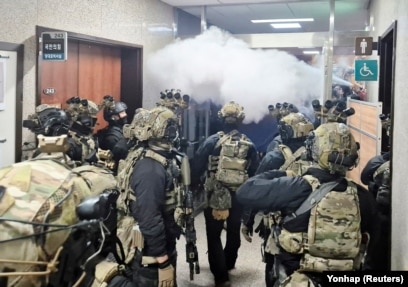
Among the most serious findings was that he ordered military personnel to detain political figures during the martial law declaration — including current President Lee Jae-myung. Troops were also deployed to the National Assembly in what the court described as an attempt to block lawmakers and cripple legislative activity.
Other Top Officials Convicted
The case extended beyond Yoon. Former Defense Minister Kim Yong-hyun received a 30-year prison sentence for his involvement in the operation. Ex-Prime Minister Han Duck-soo was handed a 23-year term, while former Interior Minister Lee Sang-min was sentenced to seven years.
All defendants have one week to file an appeal.
From Martial Law to Impeachment
Yoon’s troubles began when he declared emergency rule in a late-night address on December 3, 2024 — the first such move in South Korea in over four decades. He accused the opposition Democratic Party of Korea of anti-state activities and alleged ties to North Korea.
The move triggered immediate backlash. Lawmakers rushed to the National Assembly, where 190 out of 300 members voted unanimously to overturn the decree within hours. Clashes broke out between security forces and protesters gathered outside the parliament complex.
Although Yoon lifted the order roughly six hours after announcing it, the political damage was irreversible. He was impeached days later and officially removed from office on April 4, 2025.
Earlier, on January 16, he had already received a separate five-year sentence for attempting to obstruct his arrest after suspension from office.
Yoon became the first sitting South Korean president to be taken into custody, following a tense operation involving thousands of police officers and a standoff with presidential security personnel.
Despite the conviction, Yoon has consistently defended his actions, arguing that the martial law declaration fell within constitutional bounds and was intended to protect national sovereignty.
The historic ruling marks one of the most consequential political trials in South Korea’s modern democratic era.

