

Tech News Assistant Editor
Tez Mukamba
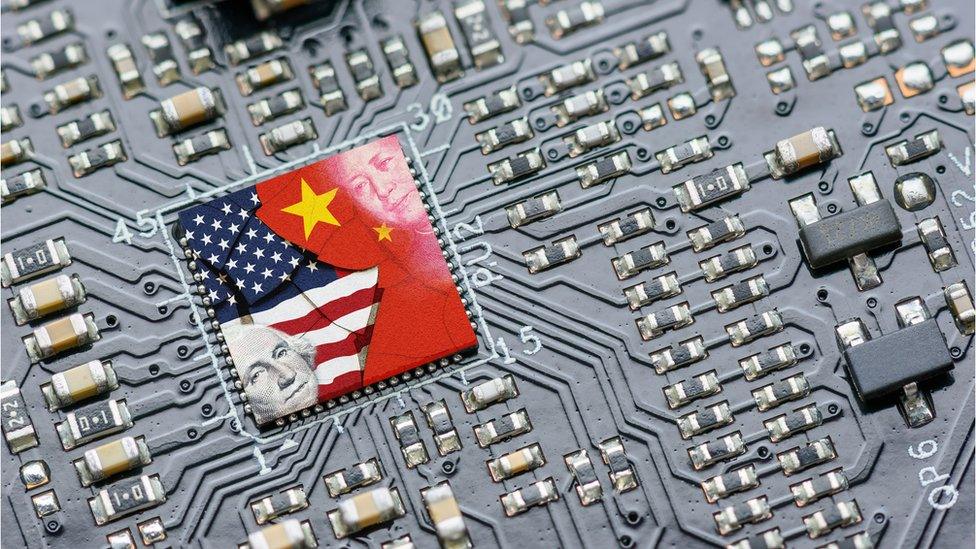
A major escalation in the global technology standoff is underway as China officially bans the use of U.S.-made AI chips — including those from NVIDIA — in all state-funded data centers, signaling a dramatic push toward AI self-reliance and a deeper technological decoupling from the United States.
According to Reuters, Beijing announced new guidelines mandating that only domestically produced AI chips be used in all newly constructed or government-backed artificial intelligence data centers. Data centers already under construction with less than 30% progress have been instructed to remove and replace all foreign chips, effectively expelling U.S. hardware from China’s fast-growing AI infrastructure.
Beijing’s Declaration of Technological Independence
The move follows Washington’s recent decision to block exports of NVIDIA’s latest AI processors, including its high-performance H100 and H200 models, to China. In what analysts describe as a “retaliatory and symbolic shift,” Beijing’s new rule marks a turning point in China’s efforts to eliminate dependence on American semiconductor technology.
Previously, Chinese firms were required to use at least 50% domestic chips in state-funded projects — but that threshold has now been raised to 100%, reflecting a bold statement of technological confidence.
“This is China’s declaration that it no longer needs U.S. GPUs to compete in AI,” said a semiconductor industry analyst quoted by Reuters. “It’s a message that self-reliance has become both a necessity and a national mission.”
Industry Impact and Economic Stakes
The ban affects hundreds of new data centers currently under construction across China, worth more than $100 billion in government investment. Companies involved are now under pressure to remove NVIDIA chips already installed and transition to Chinese alternatives — a process that could delay projects but strengthen the local chip industry.
To cushion the impact, Beijing has introduced electricity subsidies of up to 50% for AI data centers using domestic chips, encouraging adoption despite concerns about lower efficiency compared to NVIDIA’s hardware.
Rising Stars in China’s AI Chip Industry
In recent years, Chinese tech giants like Huawei and Cambricon have made rapid progress in developing high-performance AI processors. Huawei’s Ascend 910C, unveiled in 2024, achieves roughly 60% of the performance of NVIDIA’s H100, while Cambricon’s MLU590 delivers about 80% of the A100’s power — both significant leaps from earlier generations.
These advances are supported by a ¥344 billion ($47 billion) national semiconductor fund and aggressive state-backed R&D. By integrating multiple chips to boost computing power, Chinese engineers are using volume and scale to narrow the performance gap.
“China was once defenseless against U.S. chip sanctions,” said an industry expert. “Now, it’s striking back with confidence and capacity.”
NVIDIA’s Market Share Crumbles
The policy shift has already taken a toll on NVIDIA. CEO Jensen Huang recently admitted that the company’s market share in China’s advanced AI chip segment has fallen from 95% in 2022 to nearly zero. Despite this, Huang said during an AI summit in London that China is “nearly neck-and-neck with the U.S. in AI development” and could soon surpass it.
The Next Front in the Tech War
Experts warn that Beijing’s ban will further intensify the U.S.-China semiconductor conflict, with Washington expected to respond through stricter export controls and sanctions.
Financial institutions such as Morgan Stanley predict that China’s AI chip self-sufficiency rate could reach 82% by 2027, though recent developments suggest that full independence may come even sooner.
“What we’re witnessing is the start of an AI Cold War,” said Professor Lee Jong-hwan of Sangmyung University. “China’s retaliatory measures and the U.S. restrictions will push both nations to double down — making the global tech divide deeper than ever.”
As China cuts NVIDIA out of its AI data centers and doubles down on homegrown chip innovation, the world’s two biggest economies are now locked in a battle for supremacy in the future of artificial intelligence — one that could redefine global power in the digital age.

