

By John Umeh
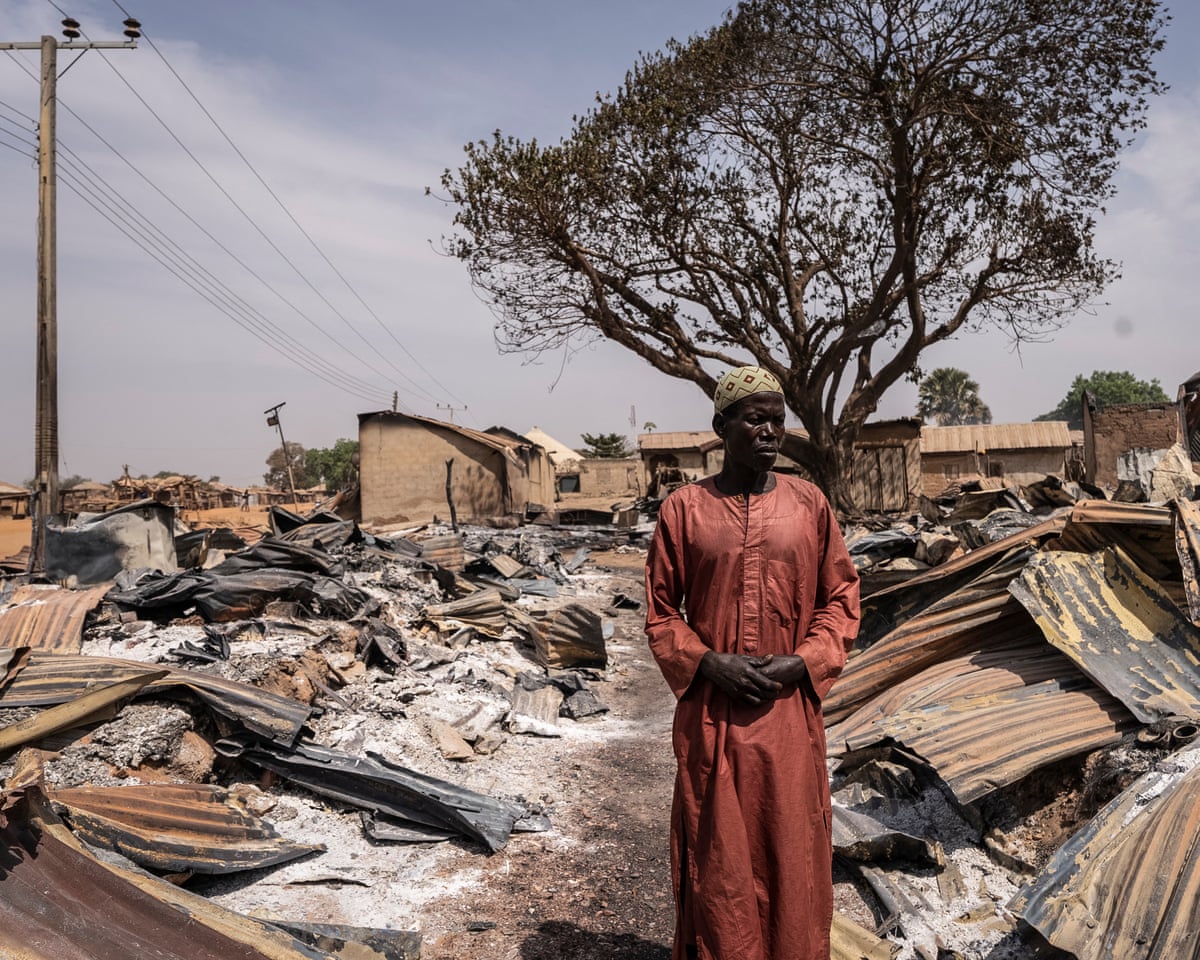
The brutal killing of scores of residents in Woro, a secluded settlement in Kaiama Local Government Area of Kwara State, has been traced to a long-running and carefully planned terror campaign rather than a spontaneous assault.
Investigations reveal that the massacre, which claimed the lives of an estimated 176 people, was the outcome of a deliberate expansion of extremist activity into Nigeria’s North-Central region—an advance that security agencies reportedly failed to stop despite early warning signs.
At the heart of the violence is Abubakar Saidu, widely known as Sadiku, a seasoned insurgent commander whose operations have quietly spread across several states over more than a decade. Once an obscure militant figure, Sadiku has now emerged as one of the most dangerous terror leaders operating outside Nigeria’s North-East.
From Boko Haram Foot Soldier to Regional Warlord
Security assessments show that Sadiku’s rise began around 2014, when he was reportedly selected by the late Boko Haram leader, Abubakar Shekau, to extend the group’s reach beyond its traditional strongholds. Initially deployed to Niger State, Sadiku gradually built influence across forested border communities.
As sustained military pressure weakened Boko Haram in Borno and neighbouring states, Sadiku shifted westward, embedding himself within the vast forest belts spanning Niger and Kwara. Over time, he evolved from a facilitator into a dominant figure, commanding fighters and orchestrating attacks that devastated farming communities and forced mass displacement.
Analysts now describe him as a North-Central equivalent of Shekau—ruthless, ideologically driven and increasingly ambitious.
Alliances, Splits and a New Base of Operations
For a period, Sadiku aligned with the notorious bandit leader Dogo Gide, using the partnership to secure weapons, intelligence and local leverage. That alliance eventually collapsed over ideological differences, triggering deadly confrontations between both camps.
Following the fallout, Sadiku withdrew deeper into the forests and, by mid-2025, established a major operational base within the Kainji Forest Reserve. This marked a strategic shift from profit-driven banditry to a more hard-line jihadist campaign, characterised by mass killings and territorial control.
Kainji Forest: A Growing Terror Hub
Spanning parts of Niger and Kwara states, the Kainji Forest Reserve has become a key convergence point for extremist groups. Security experts say the area now functions as a western counterpart to the Sambisa Forest, offering cover for recruitment, arms movement and coordinated assaults on remote communities.
From this corridor, Sadiku’s network has launched attacks across Kwara, Niger, Kebbi and parts of Kaduna, exploiting weak security presence and difficult terrain.
Links to Sahel-Based Extremists
Further intelligence points to operational overlap between Sadiku’s faction and Jama’at Nusrat al-Islam wal-Muslimin (JNIM), an Al-Qaeda-linked group active in the Sahel. The Woro attack reportedly occurred just a few kilometres from the site of JNIM’s first confirmed operation in Nigeria in late 2025.
Security researchers say patterns in recent attacks—including kidnappings and mass killings—suggest cooperation or at least a non-aggression pact between the groups, allowing them to share territory and resources around the Kainji axis.
A Warning Ignored
Evidence shows that Woro community leaders received a written notice weeks before the massacre. The letter, written in Hausa and signed by a jihadist faction, requested a private meeting with local leaders under the guise of religious preaching and claimed residents would not be harmed.
The village head reportedly forwarded the message to traditional authorities and security agencies. Despite this, no preventive action was taken.
Night of Terror
On the day of the attack, gunmen arrived in large numbers on motorcycles, sealing off escape routes. Armed with assault rifles and explosives, they struck in phases—burning the emir’s palace, executing residents and attacking travellers along the nearby highway.
Survivors say the assailants pretended to withdraw after a brief aerial presence but later regrouped, using calls to prayer to lure people out before resuming the killings. The violence reportedly continued for hours, ending in the early morning as the attackers retreated into the forest with abducted women and children.
Survivors’ Accounts
Eyewitnesses describe a coordinated operation carried out by hundreds of fighters, many dressed in military-style uniforms. Homes, shops and vehicles were torched, while residents fleeing into nearby bushes were hunted down.
Several survivors reported that the attackers planted explosives on access roads, preventing security forces from reaching the community in time. By the time troops arrived—nearly 10 hours after distress calls—the assailants had already escaped.
Why Help Came Too Late
Security sources confirmed that explosive devices planted along key routes slowed rescue efforts. Officials admitted that overstretched manpower, difficult terrain and simultaneous attacks in other regions further hampered response time.
Experts warn that without structural reforms, accountability and stronger border control, such attacks will continue. Analysts argue that extremist groups are operating with alarming freedom—raising funds, acquiring weapons and exploiting ungoverned spaces with little consequence.
Government Response
In the aftermath, the Kwara State Government has set up a committee to coordinate humanitarian assistance and reconstruction in Woro. More than 50 survivors are currently receiving medical treatment in Ilorin, while mass burials continue.
Lawmakers and community leaders have called for sustained military operations across Kwara North and renewed efforts to dismantle terror networks operating within the Kainji forest belt.
For many residents, however, the damage has already been done—entire communities emptied, livelihoods destroyed and a deep sense of fear left behind, as the shadow of Sadiku’s network continues to loom over the region.

