

By John Umeh
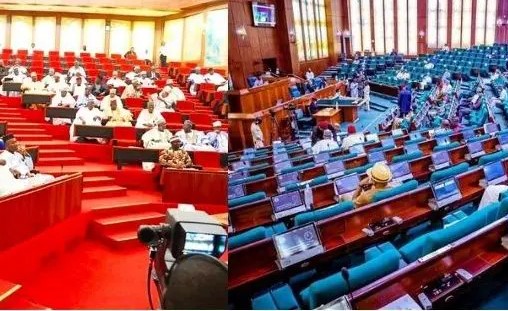
The Nigerian Senate has advanced a proposal to impose a 10-year passport ban on citizens convicted and deported from foreign countries, as part of efforts to protect the nation’s image and curb criminal activities abroad.
The measure, which has passed its second reading, is embedded in a bill to amend the Passport (Miscellaneous Provisions) Act, Cap P343, Laws of the Federation of Nigeria, 2004. The bill, sponsored by Senator Bello Sani Abubakar (APC, Niger North), seeks to prevent individuals found guilty of crimes overseas from obtaining new Nigerian passports for a decade after deportation.
Leading the debate, Senator Mohammed Onawo said the amendment is intended to serve as a deterrent and a declaration that Nigeria would no longer tolerate citizens tarnishing its global image.
“If a Nigerian is convicted abroad, his passport should be withdrawn for 10 years. This will serve as a deterrent and demonstrate that the country does not condone actions that damage its reputation,” Onawo said.
He lamented that crimes committed by a few Nigerians abroad had resulted in harsher visa restrictions and widespread discrimination against innocent citizens. “The value of the green passport has dropped significantly, and that is a national embarrassment,” he added.
Other senators, including Babangida Hussaini (Jigawa North-West), threw their support behind the proposal, urging stricter measures to prevent foreigners from fraudulently obtaining Nigerian passports. Senate President Godswill Akpabio commended the bill, calling it a “bold corrective move,” recalling instances where criminals used Nigerian passports abroad even though they were not citizens.
The bill has been referred to the Senate Committee on Interior for further scrutiny and a public hearing. If passed into law, Nigeria would join a handful of African nations that penalize their citizens domestically for crimes committed abroad.
NNPCL Under Senate Probe Over N210 Trillion Audit Queries
Meanwhile, the Senate Committee on Public Accounts confirmed receiving responses from the Nigerian National Petroleum Company Limited (NNPCL) to 19 audit queries amounting to N210 trillion. The queries cover discrepancies in the company’s financial records from 2017 to 2023.
Committee Chairman Aliyu Wadada (Nasarawa West) told journalists that the responses were still being examined.
“The NNPCL requested additional time during our recess to compile data, and they have now submitted all necessary responses. We are reviewing their documents before making any conclusions,” he stated.
Tinubu Withholds Assent to Two Bills, Cites Fiscal Risks
In a related development, President Bola Tinubu has withheld assent to two bills passed by the National Assembly — the Nigerian Institute of Transport Technology Establishment Bill, 2025, and the National Library Trust Fund (Amendment) Bill, 2025 — citing provisions that could create fiscal instability and conflict with existing laws.
Tinubu, in a letter read by Senate President Akpabio, flagged sections of the bills that he said introduced unauthorized levies, enabled borrowing without oversight, and permitted the investment of government funds in ways that could compromise fiscal discipline.
Specifically, he faulted Section 18(4a) of the Transport Technology Bill for mandating a 1% levy on all imports and exports without Federal Executive Council approval, describing it as an “unauthorized tax burden on businesses.” He also criticized provisions allowing the Institute to borrow up to N50 million without presidential consent.
President Seeks $2.35 Billion Loan Approval
Separately, President Tinubu has asked the House of Representatives to authorize the government to raise $2.35 billion in external loans. The request includes $1.23 billion for financing the 2025 budget deficit, $1.12 billion for refinancing maturing Eurobonds, and the issuance of Nigeria’s first-ever Sovereign Sukuk worth $500 million.
In his letter to Speaker Tajudeen Abbas, Tinubu said the loans would be accessed through Eurobond issuance, loan syndications, or borrowing from international financial institutions, to help bridge funding gaps and finance infrastructure projects.
The President emphasized that the Sovereign Sukuk would attract diverse investors, deepen Nigeria’s capital markets, and support debt repayment through sustainable financing instruments.
House to Vote on 87 Constitutional Proposals
Meanwhile, Speaker Abbas announced that the House of Representatives will vote on 87 constitutional amendment proposals before December, covering key areas such as local government autonomy, judicial reforms, socio-economic rights, and devolution of powers.
He noted that the national public hearing on constitutional amendments drew strong public engagement, adding that lawmakers were committed to passing the reforms ahead of the 2027 general elections to enhance transparency, reduce electoral violence, and strengthen democratic processes.

