
Deji Osas

Toyota has taken a dramatic leap forward with the unveiling of a futuristic Corolla concept that promises to redefine the identity of the world’s most popular car. Presented at the 2025 Japan Mobility Show, the concept hints at a bold new direction for the upcoming 13th-generation Toyota Corolla, one that combines daring design with a variety of cutting-edge powertrain options, including full electric and hydrogen fuel-cell technology.
A Revolution in Design
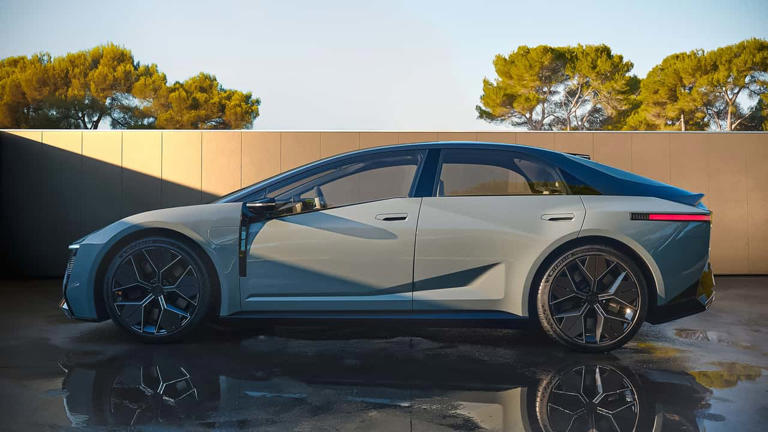
Gone are the days of the conservative Corolla. The new concept showcases a radically different aesthetic, bearing little resemblance to the current 12th-generation model. Toyota’s design team has reimagined the familiar sedan into a sleek, fastback-inspired vehicle with aggressive lines, a low-slung profile, and futuristic lighting.
At the front, the car features a two-tier lighting setup — thin daytime running lights above and projector units neatly tucked behind smoked glass. In place of a traditional grille, the front bumper incorporates active air shutters that open or close for aerodynamic efficiency.
From the side, the concept adopts proportions typical of a pure electric vehicle, with a short nose, elongated windshield, and sculpted body panels. Its sweeping roofline and dramatic glass curvature create a sporty silhouette, while 21-inch wheels and a subtle ducktail spoiler enhance its performance appeal.
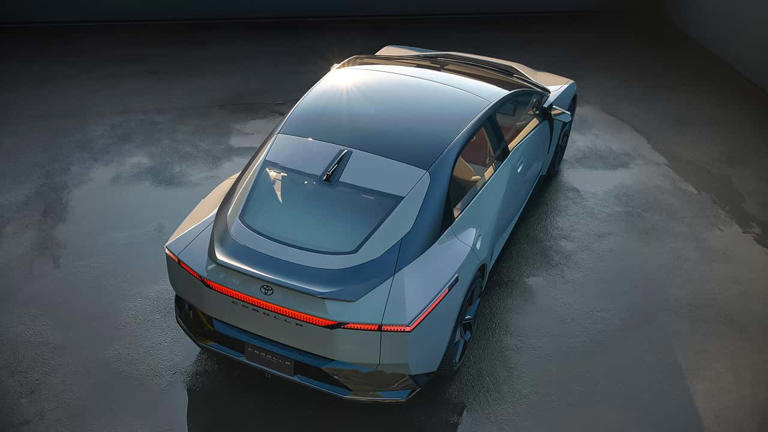
At the rear, a wrap-around LED light bar stretches deeply into the body, giving the car a dynamic, high-tech stance. The overall look aligns with Toyota’s growing family of “bZ” (Beyond Zero) electric models, but the Corolla concept stands out as sharper, more assertive, and unmistakably futuristic.
Multiple Powertrain Options — From Gasoline to Hydrogen
Underneath its striking exterior lies the most revolutionary change of all. Toyota confirmed that the new Corolla will debut on an entirely new modular platform designed to accommodate a wide spectrum of powertrains — including internal combustion, hybrid, plug-in hybrid, battery-electric, and possibly hydrogen fuel-cell systems.
This move signals a strategic shift for Toyota. Unlike in the past, where separate model lines existed for gasoline and electric versions, the company is now merging them into a single, flexible lineup.
Industry insiders suggest that the hydrogen fuel-cell variant could feature Toyota’s next-generation FCEV powertrain, similar to that used in the Mirai, but more compact and cost-efficient. While not officially confirmed, Toyota remains one of the few global automakers — alongside BMW and Hyundai — that continues to champion hydrogen as a key element of future mobility.
If all goes as planned, the Corolla could soon be available in five distinct powertrain configurations, marking it as one of the most versatile vehicles in the compact sedan segment.
A Global Vision for the Future
Toyota’s Corolla has been a global best-seller for over five decades, with more than 50 million units sold across 150 countries. The automaker plans to maintain that universal appeal by tailoring versions of the new model to suit regional preferences — meaning the design, features, and engine options could vary between markets like North America, Europe, and Asia.
In a statement, Toyota described the next-generation Corolla as a car designed to “make good-looking vehicles that everyone will want to drive,” adding that it would be “packed with inventions” — a hint at forthcoming innovations in digital connectivity, safety, and performance.
The Japanese automaker has not disclosed an official release date, but industry analysts believe the production model could debut by late 2026 or early 2027, given that the current Corolla generation has been on the market since 2018.
Reinventing a Legend
The Corolla concept isn’t just another redesign — it’s a symbol of Toyota’s transformation from a cautious traditionalist to a bold innovator ready to compete head-on with EV pioneers like Tesla and Hyundai.
With its next-generation platform, striking design language, and potential to run on everything from petrol to hydrogen, the new Corolla could become the most technologically advanced and diverse model in Toyota’s history.
In one statement, Toyota engineers summed up the company’s ambition:
“The Corolla is not just evolving — it’s being reborn for the next 50 years of mobility.”
If the concept unveiled in Tokyo is any indication, the future Corolla won’t just be the world’s most popular car — it might soon become one of its most exciting.