

By Gloria Nosa
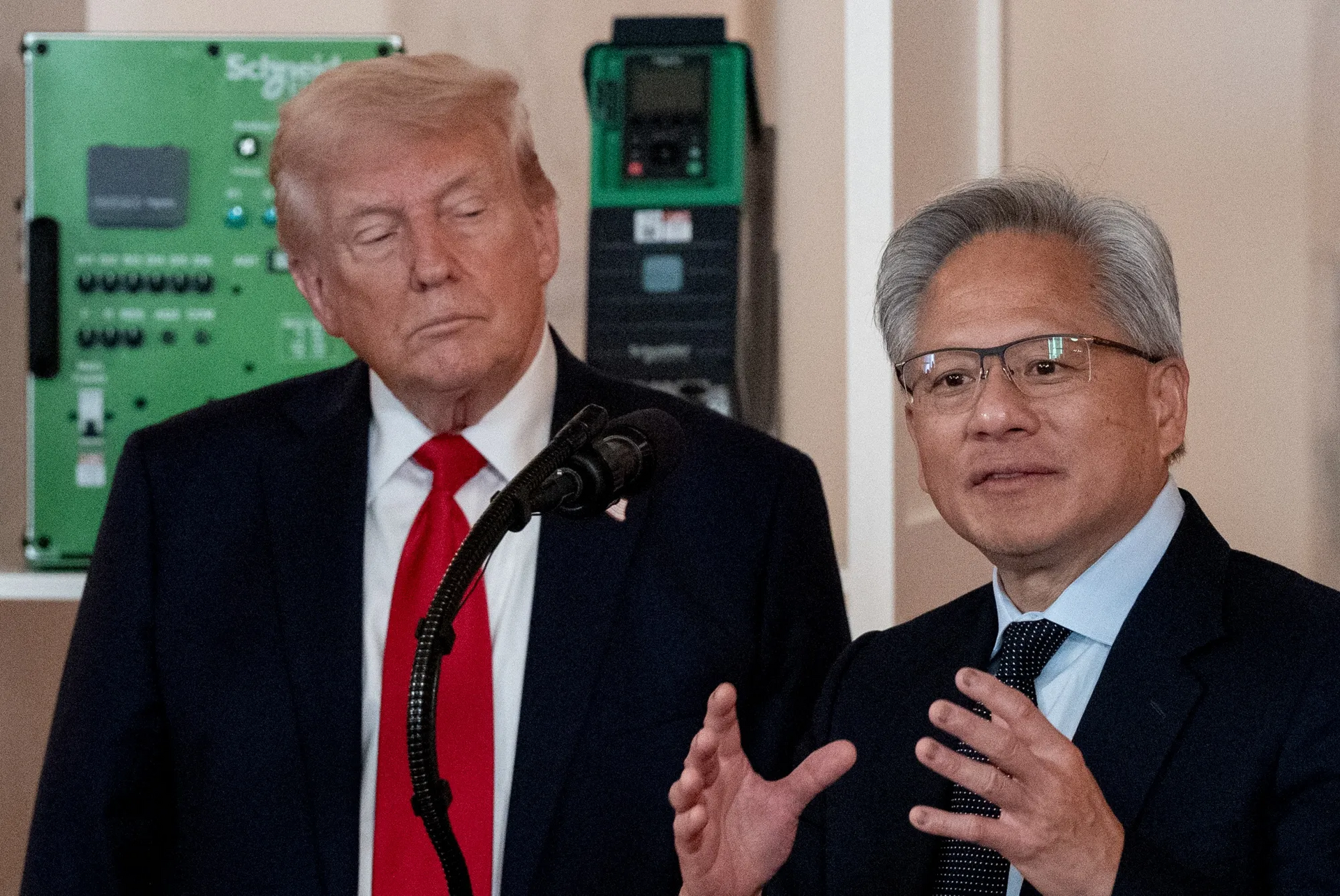
The United States has moved to partially relax its restrictions on advanced AI semiconductor exports to China, as President Donald Trump announced that NVIDIA will be allowed to sell its H200 artificial intelligence processors to select Chinese customers—under a strict profit-sharing condition with the U.S. government.
The announcement, made on December 8 through Trump’s Truth Social account, marks one of the most significant shifts in Washington’s AI export policy since curbs were first imposed in 2022.
Exports Approved—But With a Government Cut
In his statement, Trump said he had personally informed Chinese President Xi Jinping of the decision, noting that shipments will proceed only if U.S. national security remains uncompromised. The Department of Commerce is expected to finalize the regulatory framework in the coming days.
According to Trump, 25% of all revenue generated from H200 sales in China will be paid directly to the U.S. Treasury — a condition that analysts are describing as an unprecedented form of “AI export royalty.” When Washington previously allowed sales of the restricted H20 chip earlier this year, the revenue requirement was 15%.
The same export rules, Trump noted, will apply to AMD, Intel, and other U.S. semiconductor firms once their applications are reviewed.
Why the H200 Matters
NVIDIA’s H200 chip is one of the company’s most powerful processors built on the previous-generation Hopper architecture. While not as advanced as the newly announced Blackwell-series GPUs, the H200 still offers dramatic performance gains over the lower-spec H20 chips currently permitted in China.
Think-tank evaluations suggest the H200 delivers twice the inference performance and over six times the AI training throughput of the H20—making it an attractive option for Chinese cloud firms and AI developers who have been constrained by U.S. export rules.
The H200, along with the H100 and other high-end chips, had been completely blocked from export to China since Washington tightened restrictions through late 2022 and 2023.
Industry Pressure Pays Off
NVIDIA CEO Jensen Huang has been one of the most outspoken critics of the export bans. For more than a year, he has argued that restricting U.S. firms from selling advanced AI hardware only encourages China to speed up its domestic alternatives.
At an AI summit in Washington last October, Huang warned:
“The U.S. cannot win the AI race by withdrawing from markets. We win by leading them.”
Multiple reports indicate Huang has personally appealed to Trump in private meetings, presenting evidence that extended restrictions would accelerate China’s chip self-sufficiency. Monday’s approval is widely seen as a victory for that lobbying effort.
Washington’s New Strategy: Sell, But Control
U.S. officials have become increasingly concerned by the rapid progress of Chinese technology giants, particularly Huawei, whose “Ascend” AI processors have gained traction as export restrictions hardened.
Instead of maintaining a blanket ban, the Biden and Trump administrations have gradually adopted a new approach:
Allow China access to older—but still powerful—AI chips while taxing and monitoring the flow.
By doing so, Washington aims to:
-
Slow down China’s self-reliance efforts
-
Keep Chinese firms dependent on U.S. technology
-
Capture revenue that would otherwise go to competitors
-
Maintain strategic oversight of AI hardware entering China
CNN called the new policy “a pivotal shift in the U.S.–China chip war.”
Ripple Effects for Korean Chipmakers
South Korea’s major memory manufacturers stand to benefit from the approval. The H200 uses HBM3E—an ultra-fast, multi-layer memory technology supplied by SK Hynix and recently certified for use by Samsung Electronics.
With H200 shipments potentially resuming, Korean chipmakers may secure long-term demand for their HBM lines, which have become a core part of the global AI component supply chain.
Concerns Mount Over China’s Acceleration
Despite the economic upsides, some U.S. lawmakers fear that even controlled access to advanced chips may strengthen China’s long-term capabilities.
Senator Elizabeth Warren criticized the decision sharply, warning that easing restrictions could “supercharge China’s military and technological advancement” and weaken U.S. security.
There are also growing expectations that export controls on semiconductor manufacturing equipment may soon be loosened—another development raising alarms in Washington’s national security circles.


