

By Geraldine Ohonba
Health Page Analyst
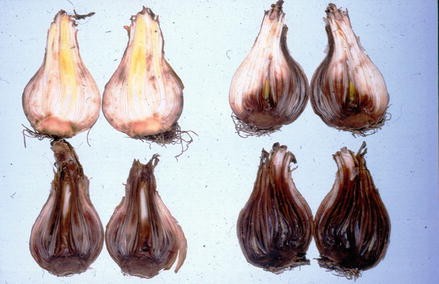
A Common Kitchen Mystery
You may have experienced it before — you grab a firm, healthy-looking onion from the basket, slice it open, and suddenly, there it is: a brown, soft, and slightly damp patch hiding beneath the crisp outer layers. For most people, it’s puzzling and even a bit alarming. Is it spoiled? Is it safe to eat?
According to agricultural experts in Japan, this mysterious browning is often caused by a bacterial disease known as “scale rot.” While the name sounds technical, the effects are something anyone who cooks regularly might recognize. The disease attacks the inner scales — or layers — of the onion bulb, turning them brown and sometimes slimy, leaving the outer skin looking deceptively normal.
Researchers at the Hyogo Prefectural Technology Center for Agriculture, Forestry and Fisheries — one of Japan’s leading institutions in crop science — have been closely studying the problem. Their findings reveal that scale rot typically begins in the soil, where bacteria lurk quietly until they find a way into the plant. The bacteria often invade through small wounds or cuts on the onion’s stem — injuries that occur naturally during growth or harvest. Once inside, they slowly cause the bulb to deteriorate from the inside out.
How Weather and Storage Make It Worse
One surprising discovery from the researchers is that weather plays a major role in how frequently scale rot occurs. In years marked by heavy rainfall, high humidity, or sudden temperature changes, the disease spreads much more easily. The bacteria thrive in wet, oxygen-poor environments, and excess moisture around the onion bulbs gives them the perfect conditions to multiply.
Even though strict safety measures are followed on farms and during shipping, onions are not entirely safe once they reach consumers. The disease can continue developing in storage, both in warehouses and in households.
Experts say there are telltale signs that an onion might be affected. In advanced cases, juice may seep from the top of the bulb, accompanied by a foul odor. However, in milder cases, it may be almost impossible to detect the rot from the outside — the onion may appear perfectly fine until it’s cut open.
Still, the Hyogo research team emphasizes that not all affected onions are immediately unsafe to eat. “If the browning or decay is limited to a few layers, you can remove the discolored portions and safely cook the rest,” one representative explained. “However, if the rot is severe or the onion smells sour, it’s best to discard it completely.”
While cooking generally kills most bacteria, eating raw onions that are even slightly rotten can pose a food safety risk, potentially leading to mild stomach discomfort or food poisoning in rare cases. The risk is higher for people with weakened immune systems.
Storing Onions the Right Way
The good news is that most cases of scale rot — and onion spoilage in general — can be prevented with proper storage habits at home. Experts advise keeping onions in cool, dry, and well-ventilated areas — such as under a shaded roof, in a mesh bag, or inside an open basket.
One of the biggest mistakes people make is storing onions in sealed plastic bags or airtight containers. This traps moisture inside, creating the warm and humid environment that bacteria love. Instead, air circulation is key.
For peeled onions, refrigeration is recommended — ideally stored in an airtight container to prevent odor transfer to other foods. Chopped or sliced onions can be frozen for longer preservation, though this may slightly change their texture when thawed. Regardless of the method, it’s always best to use onions as soon as possible after purchase, especially during rainy or humid seasons.
In the end, experts say, scale rot serves as a reminder that even the simplest foods in our kitchen are deeply connected to complex biological processes. A seemingly small brown spot inside an onion can tell a bigger story about the changing climate, soil health, and how fragile the balance of our food system really is.
So the next time you peel an onion and find an unwelcome surprise, you’ll know what’s behind it — and how to keep your onions, and your meals, fresher for longer.

